


In September 2012 almost 400 people were killed when a fire broke out in a garment factory in Pakistan. One month later 114 people were killed in a fire at the Tazreen garment factory in Bangladesh.
The reputational risk of doing business in this sector is high for buyers. Walmart refused to take shipment of US$1 million worth of clothing that had been produced in Tazreen prior to the fire.
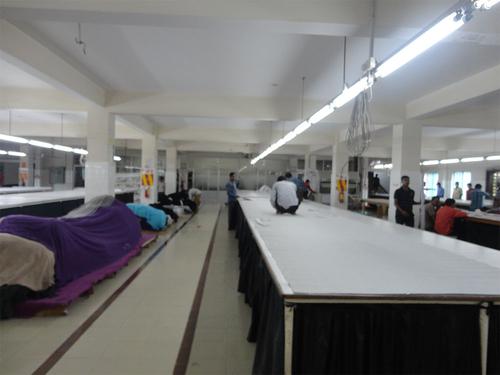
Tazreen Factory before the fire. Note the beams on the ceiling that are not big enough to act as effective smoke reservoirs and don’t have any detectors in each “cell”
A question of when it happens again
It is simple to assume that the standards in Tazreen factory were poor and that a fire was inevitable. During a visit to Bangladesh I was given photos of the Tazreen factory taken two weeks before the fatal fire. The photos could have been taken in any one of the 7,000 factories currently operating in Bangladesh. It is not a question of if there will be another major fire — it is a question of when.
Most retailers choose suppliers by auditing them against an ethical standard such as the Ethical Trade Initiative Base Code. The ETI Base Code attempts to cover all production in all countries. Rather than drilling down into the details, it asks that local auditors check that the factory complies with local fire safety standards.


Factory workers in a fire drill where 5000 people worked. It was mayhem, fire wardens screaming “run run” and took 12 minutes – rather then the 2.5 minutes the factory manager assured us it would take
Before arriving in Bangladesh I was given a list of common Non-Compliances (NCs) that Bangladeshi auditors had identified. The most common NC was that a fire extinguisher was missing. Not one of the NCs was that factories are not fitted with fire doors (Tazreen Fashions wasn’t).
There is simply not a local expectation that fire doors are fitted. The factory can comply with local fire safety standards and still not ensure life safety.
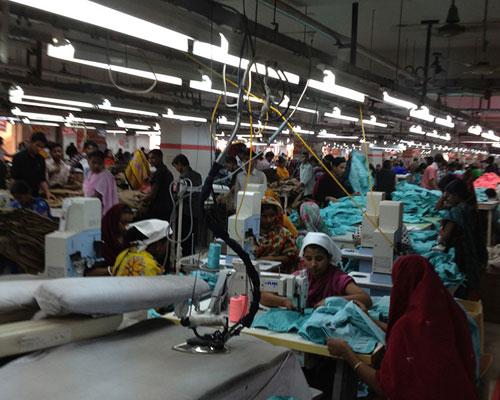
A factory floor from another Bangladesh garment factory. Note the unattended iron in the foreground.
Retailers to take active role
As local standards will not ensure life safety, retailers must take an active role in setting fire safety standards if they wish to continue to do business in Bangladesh.
Following my visit to Bangladesh, I’ve broken down some of the key contributing factors to these fires that could lead to more effective fire safety standards:
• As mentioned above, fire doors are not installed in any factory. Factory owners have never heard of fire doors (I checked), and it is not even possible to buy fire doors in Bangladesh (I checked that, too).
• Sprinklers are common in factories in the UK and growing in popularity in residential properties. I did not see any sprinklers in the factories I inspected, and factory owners I talked to did not know what sprinklers are.
• Most factories have battery-operated smoke detectors; the ones I tested did not work.
• Factories have wide beams criss-crossing the ceilings — the placement of detectors does not account for this. The large beams will stop smoke spreading and delay the activation of detectors.
• The average fire service response time in the United Kingdom last year was seven minutes. This prompt arrival allows businesses to focus on life safety rather than property protection. Due to traffic, the fire service attendance time in Dhaka is over one hour. Within Ashulia — where the greatest number of factories is located — there are no fire stations at all.
• In the UK, factories are generally located in non-residential areas where the buildings can spread out as businesses grow. In Bangladesh unreliable power supply has pushed production into urban centres. The high cost of land has forced factory owners to build up as their businesses grow.
• Factories are five to 13 stories high. Most fire truck ladders can only rescue people from the first seven floors.
• In the West, factories tend to be one or two stories, and evacuation times are expected to be around three to six minutes. Evacuation from multi-storey buildings is more complex and time consuming. The work of well-meaning buyers from the West means that Bangladesh ETI auditors are asking factory owners to meet the three-to six-minute rule without understanding that it is simply impossible to evacuate a 13-storey building with 5,000 workers in six minutes. As a result, there have been a number of injuries from running workers tripping and being crushed.
• In-house fire safety training is not common (and is unlikely to be effective at this point). There are not enough fire trainers in Bangladesh to serve the number of factories, so fire wardens only receive training about once every two years.
• 40 percent of fires are caused by electrical problems — there is no recognised industrial body such as NICEIC in Bangladesh.
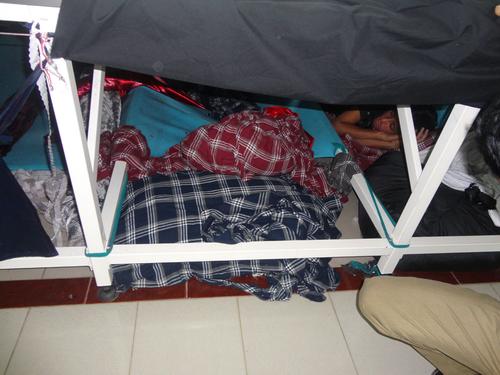
The tables in Tazreen Factory, and others, hide a range of combustible materials as well as, occasionally, the odd sleeping person.
So, what next?
A standard must be set using this information — one that will ensure life safety in a manner that the local standard will not.
If you work for a large retailer as a fire expert, then your ethical team most probably needs your help.
If you’re an ethical manager, then find the fire expert in your company. Ask around the property and construction side of your business, and there will be one willing to offer a hand.
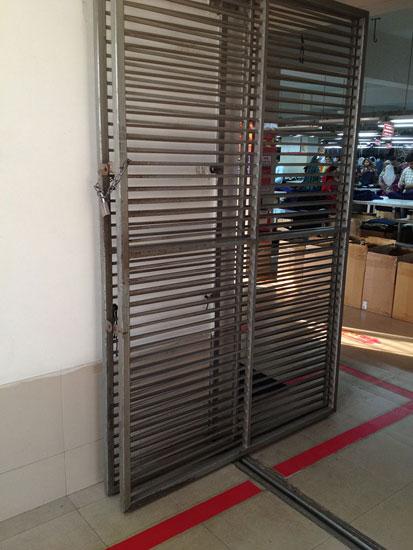
The sliding gates that factories have at each storey entrance – rather than fire doors.
Please let me know your thoughts on what would make an effective standard.