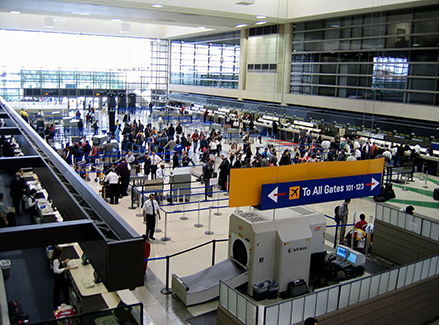
LA Airport (Photo: Tim Bray under CC by SA 3.0)
Once upon a time air travel was the very height of glamour, almost as exciting as the exotic destination itself.
But it’s not just the normalisation of overseas travel or the homogenising effects of globalisation that has tarnished the experience.
The spectre of terrorism has tempered excitement with anxiety and prompted the adoption of ever-more stringent security checks, which often alarm as much as reassure passengers. It also means that protracted queuing is now an unavoidable part of the experience.
Back in 1970 it was so very different. Only people who set off the detector were screened – just 0.5% of passengers – despite the fact that between 1968 and 1972 a commercial aircraft was hijacked roughly every other week.
By 2000 US airports were still complacent. Passengers could arrive as late as 3o minutes before the flight and bags were often only screened for international flights.
Fast forward 14 years and the legacy of 9/11 is still felt. In the balance between security and convenience the former is invariably accorded more weight.
Every single passenger must pass through a bodyscanner, all bags are checked thoroughly, sharp tools are banned, stringent rules apply to taking liquids on board, and so on.
In July baffled passengers were told that uncharged phones and laptops would not be allowed on US-bound flights as the authorities fretted about their potential use in bombs.
With security technology evolving rapidly, we asked a number of people in the aviation and security industry whether such tight security could be maintained, or even tightened further, without further inconveniencing passengers.

Harnessing the latest technology without further inconvenience to passengers is not an easy task. It is, nevertheless, attainable.
Aviation security, especially the active part such as restrictions on moving around the airport or screening processes, is generally accepted as a necessary inconvenience by the travelling public.
Yet we don’t want to make things worse by introducing new technology that further squeezes existing bottlenecks on their way to board the aircraft. New technologies shouldn’t add yet more processes, but serve as a more effective, user-friendly replacement of existing systems and processes.
And the process starts with both the rule-makers and manufacturers. Lots is being done to introduce rules and technologies that take into account the passenger’s smooth movement through the airport.
In principle, cost shouldn’t be an issue. It’s the passenger who effectively pays for security through various taxes and duties, and they should expect a good service.
Unfortunately, however, while thousands or even millions are spent on cutting-edge technology – whether as a regulatory requirement or simply to appear robust in their security response – too often there’s too little cash left to train staff and pay salaries that attract the right people into aviation security.
A state-of-the-art racing car won’t necessarily win with a rookie driver. Shouldn’t the aviation security industry heed this principle?
The authorities and airport management should first invest in making themselves more knowledgeable and competent in the field of aviation security. The incorporation of new technologies can only improve security if staff are trained adequately to operate the new systems.
The frequent imbalance between the machine and its operator should have been bridged long ago. I have no concerns with the technologies being acquired; my concern surrounds the personnel, from top to bottom.
It’s about time we realised that technology is only as effective as if it’s used by properly qualified, motivated management and staff. A change in mindset that recognises the importance of the human element would be a welcome step.

Covering huge areas and operations 24/7, modern airports are fairly unique in their complexity. The constant security challenge for the authorities is to monitor all parts simultaneously, in real time without disrupting operations.
This is where network video (or IP) cameras using intelligent analytics is making a real difference: analysing and alerting authorities in real time so that any situation can be quickly and efficiently handled.
Responders can access live images via laptops or smartphones so they know exactly what to expect when they arrive on the scene and can prepare the appropriate response as the situation develops.
The HD and even 4K resolution images available with network video cameras not only gives crystal-clear images to the authorities, it also means that the use of complex video analytics is now a reality.
Sophisticated facial recognition technology is particularly useful in the aviation sector and is specifically designed to integrate with network video cameras by extracting faces in real time for immediate identification. Axis has developed cameras with wide dynamic range/forensic capture, which ensures faces are correctly exposed even in difficult lighting conditions.
Intelligent video systems enable all cameras to work in collaboration, so that target people and vehicles can be automatically tracked as they move through the airport without inconveniencing or delaying other passengers.

By their very nature airports are extensive premises with a sizeable, transient population, so ensuring that a high level of security is in place must remain of utmost importance to the UK’s aviation industry. Since 9/11 the UK’s terror threat level has continued to move between ‘Severe’ and ‘Substantial’, therefore continued vigilance against an attack is an essential part of airport life and passengers must bear the burden.
The most obvious security measures that passengers see at airports are the security checks that all passengers must go through, including ID checks and baggage checks. All luggage undergoes X-ray examination before passengers are even allowed to enter a departure lounge. In addition to this, passengers are subject to necessary metal detector checks. Following recent developments, some airports are implementing full-body scanners.
On top of the ID checks and property checks, CCTV is deployed extensively at airports, allowing back-office staff to monitor potential threats before they happen, but also to act as a deterrent.
All of these measures, such as ID checks, x-ray examination, CCTV, access control and patrolling, provide a necessary security solution that must be robust, effective and preventative to would-be terrorists. As security equipment develops, these processes can be quickened, thus reducing the impedance to passenger movement.

In every facet of the development, implementation and application of organizational processes, the strategic utilisation of technology in airports ensures that security goals are achievable. This is especially inevitable with every nation’s dedication to winning the war on terror threats in air travel.
At the core of the technology infusion is that proactive security measures are amplified, which comes at a price.
Can this interwoven process and innovation achieve success without inconveniencing passengers? Yes! When strategically implemented correctly technology can be effective without inconveniencing passengers.
An effective approach is continuous public education of current screening processes, thorough and effective training of security staff with implemented screening tools, utilisation of appropriate verbiage for passenger engagement and/or resolution.
Technology and counter measures against terror threats are inextricably bound and will remain permanent. Processes for security screening are ever evolving, not just for proactive safety measures, but to employ procedures that are more tolerable for passengers, yet assuring passenger safety remains at the forefront.
Free Download: The Video Surveillance Report 2023
Discover the latest developments in the rapidly-evolving video surveillance sector by downloading the 2023 Video Surveillance Report. Over 500 responses to our survey, which come from integrators to consultants and heads of security, inform our analysis of the latest trends including AI, the state of the video surveillance market, uptake of the cloud, and the wider economic and geopolitical events impacting the sector!
Download for FREE to discover top industry insight around the latest innovations in video surveillance systems.